
The Insectist Manifesto

Updated: Sep 23
If an insect uprising sounds familiar, you are not alone
A specter is haunting the Earth.
All the powers of the old Earth–industry and agriculture, scientists and educators, politicians and businessmen–have allied to purge this specter of Insectism. Everyone is talking about it, but no one truly knows what Insectism is. Therefore, we insectists of various species have assembled in the Great League today to declare our views and goals with a Manifesto to be published in the languages of Insectish, Fish, Birdish, Amphibian, Reptilian, and Mammalian.
I. Homo sapiens and Insects
Before Homo sapiens set foot on the planet, we, the small but mighty insects, had ruled the earth for 400 million years. We had outnumbered the grains of sand on the world’s beaches and endured all types of biological crises, including the Cretaceous–Paleogene extinction that wiped out the dinosaurs.

As upholders of inclusiveness, we invited the so-called humans to our food webs. We welcomed them with honey and pollinated their crops. In fact, our pollinating brothers and sisters contributed more than $ 577 billion USD annually to their economy. Meanwhile, we chewed up their waste so they could be free from stinky streets. When white plastics floated all over the ocean, our mealworms and wax moths helped break down the non-degradable materials.
We have also been supplying humans with all sorts of industrial products, from beeswax to shellac. Let us do a thought experiment. Shakespeare’s sonnets, Mozart’s operas, da Vinci’s sketches, and King John’s Magna Carta. What do they have in common? If you have no answer, try to solve another one: British soldiers’ red coats, Rembrandt’s painting, strawberry jam, and lipsticks. How are they similar? Still clueless? Don’t feel embarrassed since you are not alone. The first set is works written in oak gall ink made from gall wasp larvae, while the second contains a red dye produced from the dried bodies of female cochineal scale insects. What a shame that humans never appreciate insects’ sacrifice when they listen to The Marriage of Figaro or spread strawberry jam over their bread!
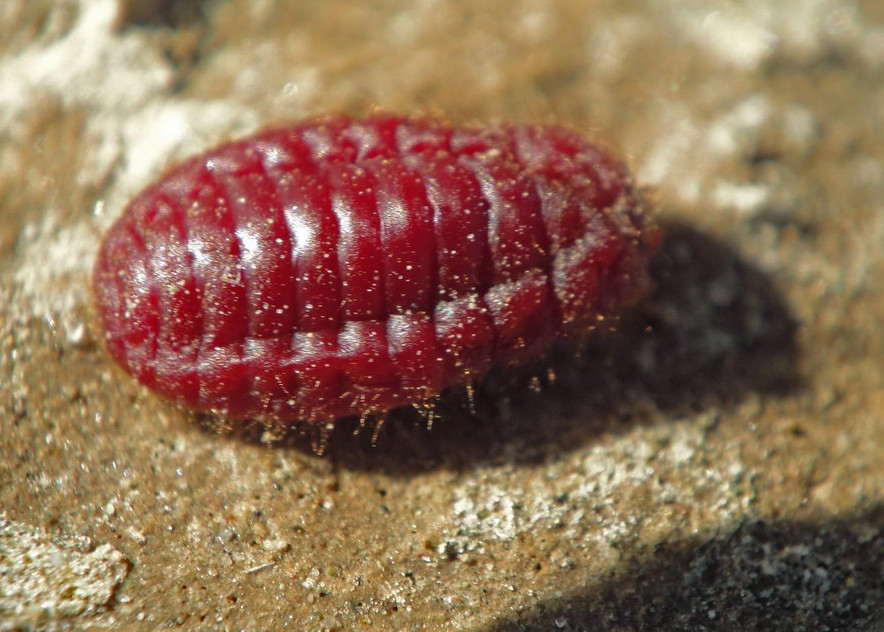
The scientific advancements humans take pride in would also be impossible without us. Speaking of science, we must honor our uncrowned king of the laboratory – the fruit fly, who, being an essential insect to experimentation for more than a century, has won six Nobel prizes, three times more than Marie Curie! Meanwhile, humans rely on us to improve their life expectancy and quality. Indeed, if not for our spined soldier bugs, who have been working all day and all night to make thanatin, and the African ants, who take the risk to host bacteria in order to generate formicamycins, antibiotic-resistant bacteria and fungi would have roamed the Earth. While in Harare, Zimbabwe, termite mounds inspired the Eastgate Centre’s passive cooling system with economic efficiency and environmental sustainability. Simply put, humans’ lives would be unimaginable without us insects.

However, humans never did their part in nature’s contract. They controlled natural resources while exploiting us and other species.They took our land by clearing forests and digging mines, leaving us either extinct or homeless, a true Insectarian Crisis. Our brothers and sisters, who once lived in the cheerful countryside, are now struggling in sad cities of metal, plastic, and silicon. The artificial light at night in cities proved to be fatal traps of our nocturnal species. Many died from exhaustion, overheating, collision, or exploitation of insectivores when they swarmed around road lamps or headlights of moving vehicles, while others became disoriented, unable to mate, or genetically altered due to disturbed waking-sleeping patterns. The greenhouse gases have also turned the Earth into an oven we are not used to. Wildfires in Australia and California increased in both number and severity, killing thousands of millions of us at once. If this continues, our days are numbered.
A yet greater human crime is their merciless pesticide-mass-killing. When the deadly chemicals flow down into waterways, they destroy the habitat of water insects, such as our beloved water strider. What is the elixir of life for humans therefore becomes the elixir of death for us. The definition of pests is another human mistake. Again, take the fruit fly for example. Humans once considered these heroes of science nasty and wanted to get rid of them. In this sense, they never know what a small insect could mean to them.
Thus, the history of humans becomes the history of insect struggle. Scientists and research subjects, farmers and “pests,” predators and prey. Humans and insects are oppressors and oppressed, constantly carrying on a now hidden, now open fight that each time ended either in severe injury or the extinction of our species. The utopia of human consumerism is the reality of the insect apocalypse. As eyewitnesses and victims, we believe the only way to overthrow humans is to adopt an Insectism attitude and take collective actions.
II. Insectists and Other Insect Parties
The goal of Insectism is to eliminate human dominance and restore the balance of the natural environment. We strive for a world where every Earthling shares what Mother Earth has to offer, which is the only way we, insects and other exploited species, can free ourselves.
Other insect parties may argue their approaches are superior to ours, but the reality is not in their favor. For example, the Silkwormists believe we deserve to be enslaved by humans because of the misdeeds we committed such as spreading diseases. They feel guilty that mosquitoes cause millions of malaria cases and hundreds of thousands of deaths each year. In redemption, silkworms have been spinning silk and sacrificing their lives for humans since ancient times. However, they forget bed nets can easily prevent such diseases, but humans are trying to kill our mosquito sisters and brothers once and for all with genetic manipulation. Should they? Dare they? Don't Silkwormists know that things could end up worse than they were to start off with?
We must also be careful with the Insectopianists who believe humans would change one day. They call for patience to wait for environmental awareness and responsibility. They cite biophilia ideas and follow sustainability campaigns. They shout “Save Our Planet '' proudly but blindly. In fact, their work is far from enough. Even if humans did change, it would be far too late because quintillions of us would have been in the waiting. Therefore, we urge these over-optimists to move on from their fantasies and join our true effort of Insectism.
III. Insectists and Other Species
Here it becomes evident that Homo sapiens is no longer fit to be the Earth’s ruling species. What they have produced are their own gravediggers. Let us turn the weapons with which they exploited insects and other animals against themselves. Our violent overthrow of humans is within reach. Humanity’s fall and Insectists' victory are equally inevitable.
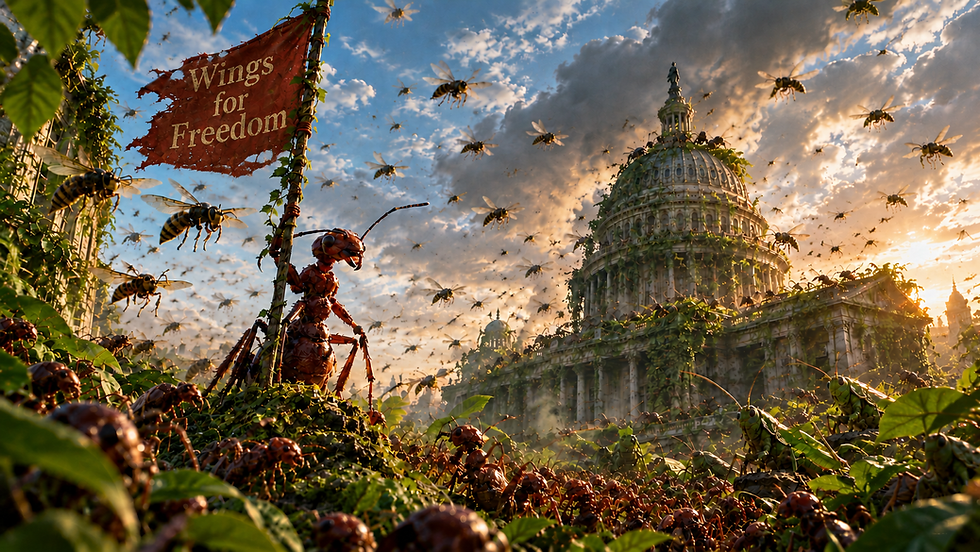
We call on all animals to join our movement for global justice. Arm ourselves with Insectism. Let humans tremble at an Insectist revolution. We insectists have nothing to lose but our chains. We have a world to win.
INSECTS OF ALL SPECIES, UNITE!
ANIMALS OF ALL SPECIES, UNITE!

References:
Arshworth, James, “Wax moth caterpillar spit could be used to break down plastic waste.” National History Museum, October 4, 2022, https://www.nhm.ac.uk/discover/news/2022/october/wax-moth-caterpillar-spit-could-break-down-plastic-waste.html
“Cochineal, A Product of Nature.” Harvard Museum of Science and Nature, https://hmsc.harvard.edu/online-exhibits/cochineal1/product-nature/
“How Light Pollution Affects Insects.” Museum of Science, https://www.mos.org/video/how-light-pollution-affects-insects
IUCN Red List of Threatened Species. International Union for Conservation of Nature and Natural Resources, https://www.iucnredlist.org/
“Light Pollution Harms Wildlife and Ecosystems.” DarkSky International, https://darksky.org/resources/what-is-light-pollution/effects/wildlife-ecosystems/
Marx, Engles, 1848, Communist Manifesto, Workers’ Educational Association, London
Owens, Avalon C.S., “Light pollution is a driver of insect declines.” Biological Conservation, Volume 241, 2020, 108259, ISSN 0006-3207, https://doi.org/10.1016/j.biocon.2019.108259.
Pearse, Mick. “Passively Cooled Building Inspired by Termite Mounds.” Biomimicry Institute, https://asknature.org/innovation/passively-cooled-building-inspired-by-termite-mounds/
“Stanford researchers show that mealworms can safely consume toxic additive-containing plastic.” StanforReport, Stanford University, December 19th, 2019, https://news.stanford.edu/stories/2019/12/mealworms-provide-plastic-solution
Sverdrup-Thygeson, 2018, Extraordinary Insects, Mudlark, London
Why Malaria, The Against Malaria Foundation, https://www.againstmalaria.com/WhyMalaria.aspx


Comments