
A heavenly blue turned to living hell

Updated: 3 days ago
As cobalt becomes essential to the digital and renewable economy, its supply chain raises human rights concerns in the DR Congo.
As far back as 1600 BCE, ancient Egyptians used the pigment to color amulets, jewellery, and deity portraits. The Romans also prized its deep blue color to glaze the Portland Vase. Today, worshippers still admire its azure hues adorning the stained-glass windows of the medieval Canterbury Cathedral in England.
Indeed, civilizations have associated cobalt blue with the supernatural well before Swedish chemist Georg Brandt first isolated it as a distinct element in 1735. However, only after John Goodenough invented the Nobel Prize-winning lithium-ion battery with a cobalt cathode in 1980 did the metal reveal its power to manipulate societies. The battery not only powers electronics that fuel our digital age but also electric vehicles pivotal to the green energy revolution. For instance, in 2024, all top ten EV models in the U.S. and Europe relied on cobalt. As the urgency of combating climate change grows, the World Bank projects cobalt prices will continue to rise until at least 2040.

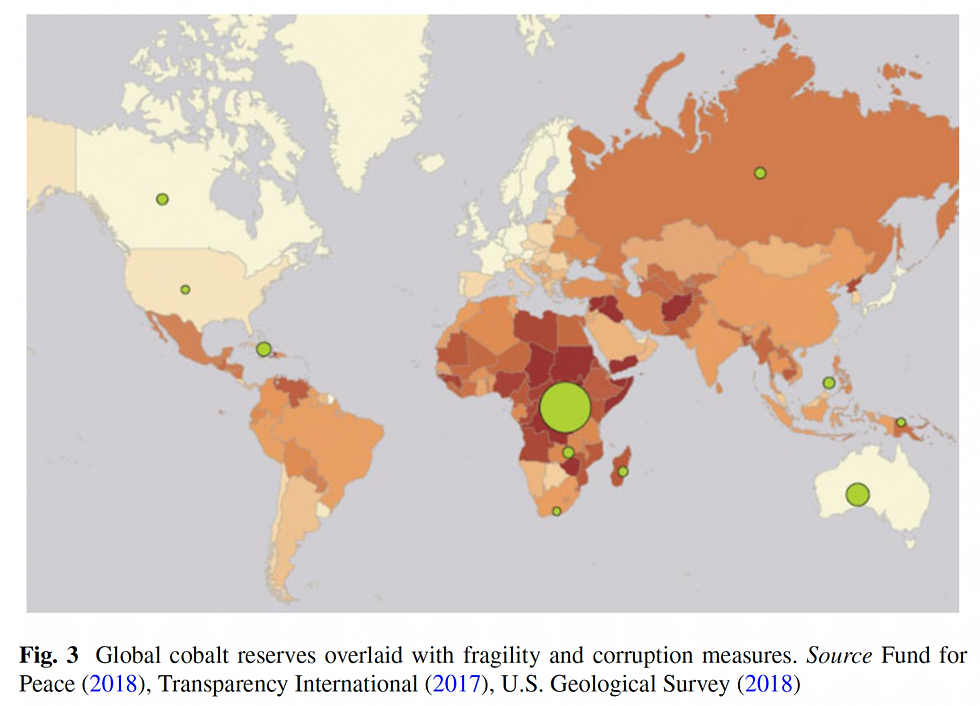
Like many strategic minerals, most of the world's cobalt concentrates in one region. The Democratic Republic of Congo (DRC) sits over 55% of global cobalt reserves and produces around 70% of the world's supply, often as a by-product of nickel and copper refining.

Most of these cobalt reserves cluster in the Southeastern DRC in the Central African Copperbelt, which stretches from the historical region of Katanga down to Zambia's northern border.

One would expect the DRC's vast resources to secure it a spot among the world's most prosperous nations. However, the DRC remains a least developed country (LDC) with a Human Development Index (HDI) of 0.522, placing it in the bottom 25 countries globally as of 2025. In fact, the mining region of Katanga has an even lower regional HDI at 0.507. Moreover, with national literacy rates below 80%, over 75% of the population living with no electricity, and only 12% having access to clean running water at home, the mineral wealth has also failed to translate into infrastructure for its citizens.
The DRC's cobalt revenues have instead flowed to foreign nations. Up the supply chain, multinational mining corporations such as China's Huayou take a major cut of earnings from raw cobalt ore. Downstream, technology companies from Apple to Tesla make trillions of dollars in profit from their electronics and EV sales.

Cobalt extraction at the expense of the Congolese people traces itself to the period of Belgian rule. In 1914, geologists representing the Belgian company Union Minière du Haut-Katanga first discovered cobalt in the now-DRC. Union Minière would control cobalt production even after the DRC's independence in 1960, only relinquishing its monopoly when dictator Mobutu Sese Seko nationalized the mining industry in 1967. However, rather than allowing cobalt revenues to benefit citizens, Mobutu pocketed much of the seized wealth for his personal fortune.
When Mobutu's regime crumbled in the 1990s, the First and Second Congo Wars terrorized Central Africa, causing a combined death toll of 5-6 million. Ultimately, Chinese-backed rebel leader Laurent-Désiré Kabila became president of the DRC. Around the same period, the Chinese government began incentivizing private businesses to introduce foreign direct investments (FDI) into Africa to secure cobalt and other minerals for strategic industries. As a result, Chinese investments played a crucial role in reviving the DRC's post-war copper-cobalt sector, allowing Chinese corporations such as Huayou to obtain extensive mining permits. As a result, China now owns 15 out of the DRC's 19 largest cobalt mines.
By then, Western businesses, deterred by the DRC's instability, had begun to diversify investments away from the country. However, those that remain have also colluded with the DRC's new regime. For example, diamond magnate Dan Gertler, joining forces with Swiss commodity giant Glencore, secured five major copper-cobalt concessions through personal ties with Laurent Kabila's successor, his son Joseph Kabila. Thus, after a century of foreign intervention and domestic corruption, the Congolese people have never truly benefited from the cobalt beneath their own soil.
However, Congolese citizens dwell at the bottom of the industry's hierarchy as mining laborers. Cobalt extraction takes two main forms: large-scale industrial mining (LSM) and small-scale and artisanal mining (ASM). Although ASM only produces about 12% of the global supply, it employs up to 200,000 miners, who represent the most endangered members of the industry since they often work without permits or oversight. Poor safety conditions, child labor, environmental degradation, and financial abuse characterize the most serious human rights violations these miners encounter on a daily basis. Perhaps most unfortunately, consumers often purchase products containing cobalt unaware of these atrocities since the branding of "clean tech" often obscures the human costs of the supply chain. Only in 2016 would an Amnesty International report finally bring the flaws of the DRC's cobalt industry to global attention.
For one, miners face a range of safety hazards against which they have little protection. In ASM operations, tunnels often reach over 30 meters deep with holes dug at steep angles. Neighboring mining shafts often meet due to unplanned digging, further compromising structural integrity. As a result, cave-ins and mining embankment collapses occur regularly, and since miners often work without protective gear, these incidents often prove fatal. One such disaster occurred in September 2015 when 15 miners died in a cave-in in Mabaya. Ten years later, 32 more miners succumbed to an even deadlier accident when a bridge collapsed at a semi-industrial copper-cobalt mine in Lualaba. Moreover, miners could spend up to 24 hours inside a hole at a time with little access to oxygen. After extracting cobalt from the ground, workers then carry heavy sacks of over 50 pounds to load them onto trucks, causing physical trauma to their arms. Throughout the process, exposure to heavy metals and toxic chemicals remains a constant reality.

Child labor marks another human rights violation in the cobalt mining industry. Due to mismanagement of government finances, public schools often charge fees to make up for inadequate funding. With education inaccessible to those who could not afford the tuition, children as young as five or six instead work in cobalt mines to supplement the household income. Arthur, a 13-year-old child miner, testified to Amnesty International that he worked in the mines because "Papa is unemployed" and his parents "couldn't afford to pay for food and clothes." Child laborers such as Arthur fulfill a variety of jobs, including artisanal cobalt digging, loading trucks with cobalt sacks, as well as sorting and washing ores. The poisonous materials and heavy loads inherent to these duties stifle the children's physical and mental development. Their young age also makes them vulnerable to abuse from adults, such as beatings from security guards. In total, UNICEF estimated in 2014 that about 40,000 children worked in mines in Southern DRC, many of them in the cobalt business. Little has changed since then as the structural issues behind child labor remain largely unaddressed.

Moreover, cobalt mining and processing come at a great environmental cost, endangering the health of the Congolese population. Mining operations fill the surrounding air with toxic cobalt dust and radioactive radon. Ore-washing also acidifies waterways of the Congo River basin, and the metal that enters fish eventually passes back into humans. Mines close to residential communities pose an even more serious risk of diseases such as cancers, dermatitis, and hard metal lung disease. Unsurprisingly, pregnant women suffer disproportionately from the toxic environment, as evidenced by high occurrences of deformed newborns, stillbirths, malformations, and premature deliveries. Such environmental concerns reached a breaking point in November 2025 when a dam belonging to Huayou collapsed near Lubumbashi, spilled "several million cubic meters of electrolytes," flooded hundreds of homes, and threatened the public health of the city's over 2.5 million residents.

Cobalt miners also fall victim to financial abuse. Miners typically receive a daily wage ranging from $2-5 USD, meaning many live below the World Bank extreme poverty line of $3 USD per day. Recent reports highlight the practice of scale-cheating, in which Chinese companies manufactured biased weighing scales to undervalue the ores brought by miners. Meanwhile, indebted workers live under bondage such that their creditors essentially own their labor as a modern form of slavery. The University of Nottingham Rights Lab estimates that 6.5% of ASM workers live under such conditions. Furthermore, when industrial cobalt mines expand, corporations often evict local residents from their homes without consent and offer inadequate compensation to buy similar housing.
Instead of enforcing laws to protect laborers, DRC government officials participate in the predation of miners through corruption. Authorities regularly fabricate reasons to extort payment from workers, such as charging ASM workers for using unauthorized mine sites or taking a commission for each sack of ore produced. An Australian Broadcasting Corporation documentary captured one such case of bribery in which a local district chief extorted a payment to allow a mother to lay a cross on the grave of her 13-year-old son, who died in a mining accident.
Current human rights enforcement mechanisms have clearly failed to prevent foreign corporations and domestic authorities from exploiting Congolese miners for profit. On the surface, most companies do acknowledge their responsibility to observe due diligence guidelines, which the Organization for Economic Co-operation and Development (OECD) defines as a six-step process “to identify, prevent, mitigate, and account for how [corporations] address their impacts on human rights.” However, since no government requires corporations to follow due diligence by law, businesses rarely conduct the OECD's recommended measures to full rigor. Furthermore, poor traceability makes accountability even more difficult, since cobalt ores often change hands multiple times from miner to refiner. In response, Human rights organizations such as the Responsible Minerals Initiative (RMI) have strove to clean the industry by proposing certification standards for abuse-free cobalt. For example, since 2020, RMI has developed an ASM Cobalt Normative Framework as a standard for ethically sourcing the metal from artisanal miners. However, the framework remains in draft form and carries little impact without legally binding status.
Before structural change could occur, immediate solutions must prioritize protecting workers. Simple additions such as providing safety gear to laborers could drastically improve their safety and wellbeing. Meanwhile, miners must receive education on their rights and form cooperatives to defend themselves. The DRC's government must also enforce existing human rights laws, most notably the 2002 DRC Mining Code. To keep children away from mines, the state must provide a free public education. Fortunately, local organizations such as the Congregation of Our Lady of Charity, an organization of Catholic nuns in the DRC, have already begun to address the gap by starting their own school, which educates nearly 1000 pupils formerly working in artisanal mines. Their institution charges no tuition, provides students one free meal a day, and employs staff to persuade local families to send their children to school.
Outside the DRC, the world must decrease its reliance on unethically sourced cobalt. On one hand, evolving technology has made the replacement of cobalt with other chemicals such as lithium iron phosphate a possibility. Corporations can also import cobalt from countries like Finland who produce it with more stringent environmental regulations. These measures will not only clean up the supply chain but also incentivize the DRC itself to improve its industry practices to remain a supplier of choice for the global market. Human rights watchdogs like Amnesty International must continue to track the DRC's progress to ensure it fulfills the cobalt industry's long-needed overhaul. Thanks to their scrutiny, consumers could finally buy their conscience at the marketplace.
A component of both majestic cathedrals and a carbon-free future, cobalt has always served as an ingredient in society's greatest achievements. However, unchecked morality in pursuit of its divine qualities could also bring out the worst of humanity's greed and violence. Corporations, governments, consumers, and the international community must together decide if a heavenly blue will fuel the development of Africa's dormant power or feed the flames of a living hell.
References:
Al Jazeera Media Network. "Cobalt Miners: The Human Cost of Clean Energy." Aljazeera. Last modified December 3, 2025. Accessed May 24, 2026. https://www.aljazeera.com/video/witness/2025/12/3/cobalt-miners-the-human-cost-of-clean-energy?utm_source=chatgpt.com.
"Blood Cobalt: The Congo's Dangerous and Deadly Green Energy Mines | Foreign Correspondent." Video. YouTube. Posted by ABC News In-depth, February 24, 2022. Accessed May 22, 2026. https://www.youtube.com/watch?v=_V3bIzNX4co.
"Cobalt Facts." Government of Canada. Last modified January 5, 2026. Accessed May 23, 2026. https://natural-resources.canada.ca/minerals-mining/mining-data-statistics-analysis/minerals-metals-facts/cobalt-facts.
"Cobalt Factsheet." Cobalt Institute. Last modified July 2025. Accessed May 25, 2026. https://www.cobaltinstitute.org/wp-content/uploads/2025/07/Cobalt-Factsheet_July-2025.pdf.
Cobalt in the Democratic Republic of Congo. World Bank, 2021.
"The Cobalt Rush: The Future of Going Green." Video, 52:47. YouTube. Posted by I. Love I Love Docs, June 5, 2025. Accessed May 25, 2026. https://www.youtube.com/watch?v=pyW-7EefAP8&t=1823s.
Democratic Republic of Congo: "This Is What We Die For": Human Rights Abuses in the Democratic Republic of the Congo Power the Global Trade in Cobalt. Amnesty International, 2016. https://www.amnesty.org/en/documents/afr62/3183/2016/en/.
"Democratic Republic of the Congo: Industrial Mining of Cobalt and Copper for Rechargeable Batteries Is Leading to Grievous Human Rights Abuses." Amnesty International. Last modified September 12, 2023. https://www.amnesty.org/en/latest/news/2023/09/drc-cobalt-and-copper-mining-for-batteries-leading-to-human-rights-abuses/.
Due Diligence Essentials for Responsible Minerals. Organisation for Economic Co-operation and Development (OECD), 2026.
Finn, Brandon Marc, Sarah Backstrand, and Espérant Mwishamali Lukobo. "Transformative Cohabitation: A New Approach to Artisanal and Small-scale Mining Interventions in the Democratic Republic of the Congo." Energy Research & Social Science 135 (May 2026): 104651. https://doi.org/10.1016/j.erss.2026.104651.
Geopolitics of the Global Energy Transition, The, Vol. 73. Springer International Publishing, 2020.
Gulley, Andrew L. "One Hundred Years of Cobalt Production in the Democratic Republic of the Congo." Resources Policy 79 (December 2022). https://www.sciencedirect.com/science/article/pii/S0301420722004500.
Institute for Management Research Radboud University. "Subnational HDI (v10.2)." Global Data Lab. Accessed May 26, 2026. https://globaldatalab.org/shdi/table/shdi/.
Iragi, Elisha. "DRC: Dam Failure at Huayou Cobalt Subsidiary Reportedly Spills Toxic Water into Lubumbashi; Mine Rrdered to Suspend Operations." Business and Human Rights Center. Last modified November 10, 2025. Accessed May 26, 2026. https://www.business-humanrights.org/en/latest-news/drc-dam-failure-at-huayou-cobalt-subsidiary-reportedly-spills-toxic-water-into-lubumbashi-mine-ordered-to-suspend-operations/.
Kara, Siddharth. Cobalt Red : How the Blood of the Congo Powers Our Lives. St. Martin's Press, 2023.
"Minerals Due Diligence." Responsible Minerals Initiative (RMI). Accessed May 26, 2026. https://www.responsiblemineralsinitiative.org/minerals-due-diligence/.
Muimba-Kankolongo, A., C. Banza Lubaba Nkulu, J. Mwitwa, F. M. Kampemba, and M. Mulele Nabuyanda. "Impacts of Trace Metals Pollution of Water, Food Crops, and Ambient Air on Population Health in Zambia and the DR Congo." Journal of Environmental and Public Health 2022, no. 1 (2022). https://doi.org/10.1155/2022/4515115.
"New Report Exposes the Environmental and Human Costs of DRC's Cobalt Boom." RAID. Last modified March 27, 2024. Accessed May 26, 2026. https://raid-uk.org/report-environmental-pollution-human-costs-drc-cobalt-demand-industrial-mines-green-energy-evs-2024/.
Nobel Prize Organization. "John B. Goodenough." The Nobel Prize. Accessed May 24, 2026. https://www.nobelprize.org/prizes/chemistry/2019/goodenough/facts/.
Norton, Kara. "Cobalt Power Our Lives. What Is It--and Why Is It so Controversial?" National Geographic. Last modified December 21, 2023. Accessed May 24, 2026. https://www.nationalgeographic.com/environment/article/cobalt-mining-congo-batteries-electric-vehicles.
"Object: The Portland Vase." The British Museum. Accessed May 25, 2026. https://www.britishmuseum.org/collection/object/G_1945-0927-1.
Responsible Minerals Initiative. "ASM Cobalt." https://www.responsiblemineralsinitiative.org/asm-cobalt/.
"Responsible Mineral Supply Chains." Organisation for Economic Co-operation and Development. Accessed May 23, 2026. https://www.oecd.org/en/topics/sub-issues/due-diligence-guidance-for-responsible-business-conduct/responsible-mineral-supply-chains.html.
Shortland, Andrew J., Victoria Kemp, Lasse Hermansen Bjørnland, and Patrick Degryse. Of Goblins and Gods : 3,500 Years of Cobalt and Its Pigments. Leuven University Press, 2026.
Sovacool, Benjamin K. "When Subterranean Slavery Supports Sustainability Transitions? Power, Patriarchy, and Child Labor in Artisanal Congolese Cobalt Mining." The Extractive Industries and Society 8, no. 1 (2021): 271-93. https://doi.org/10.1016/j.exis.2020.11.018.
"Stained Glass." Canterbury Canterbury Cathedral. Accessed May 25, 2026. https://www.canterbury-cathedral.org/visit/what-will-you-discover/stained-glass/.
World Population Review. Accessed May 24, 2026. https://worldpopulationreview.com/country-rankings/cobalt-reserves-by-country.


Comments